Since Feb. 2016, I’ve encouraged myself and others on this honest blog, Roots and Hope. I love to share my heart about faith, mental health, & young adulting.
If I weren’t Peter, James, or John, I would likely ask myself and God, “How come Jesus didn’t choose me to be in his inner circle among the disciples? How come he didn’t take me up to a high mountain instead of leaving me down here with everyone else? What makes me less special than them?” If I was one of Jesus’ disciples, I would likely wonder, worry, and perhaps, argue, like them at one point, “Am I (not) the greatest among us?” These were all people that Jesus noticed, loved, and invited, personally, to intimately spend life and commit to ministry with him. The most perfect person on earth wanted them to share in his earthly story and far more. Still, this tremendous honor did not cancel out their distractions and humanity.
We all have wounds. They are like the pinches that remind us how life is real and not a dream. One of mine is that of rejection. “They probably wouldn’t want to hang out with me./I’m not surprised they didn’t text me back./Of course, I didn’t get invited./I feel invisible./I feel left out./What are they thinking about me?/Did they forget me?” I liken these thoughts to creepy crawlers. They first appeared on the walls of my childhood and annoyingly reappear along the highs and lows of life.
I don’t fully know why Jesus chose only Peter, James, and John to witness his mountaintop transfiguration and temporarily withhold what they saw from everyone else. I do understand that not everyone can handle intimate relationship with (witnessing of) us and vice versa. I also recognize that Jesus entrusted the remaining disciples to handle major responsibilities among people in urgent need of care and miracles. In this regard, he purposed all the disciples to be a part of powerful, albeit different, assignments.
I am learning to trust that God is unlimited. He will not and cannot run out of creativity. He will use anyone with a willing heart and actionable faith. One million people can each do life with God in a manner that is personal/individualized, special, secure, gracious, and worthy without comparison.
In my earthly relationships and encounters, I am learning how to count myself as whole and not a ranking. I am rehearsing how to regard my wounds within a story of healing. And, lastly, I am hoping to becoming bolder and bolder about saying, “Not today, fear. I rest in choosing God and being chosen in my own way.”
Geography ain’t innocent. In the U.S. alone, white colonizers stole and spit on land, partly through mapping, naming, occupying, and defining borders with no regard for Indigenous communities. They committed genocide and displacement while also stealing my ancestors from Africa for centuries of bondage.
Within the context of geography, I have long hoped to understand my family history. This summer, I built my family tree. The earliest relative I could locate was born in the 1890s. Because of slavery, it is outright difficult to gather older information. I thank God for family who try to help me find my way. My paternal Grandma, Jeanette, gave me her mom’s obituary the day before I left for a trip to Ghana. My Great Auntie Versy, my deceased maternal grandma’s sister, has been telling me stories all my life.
From Versy, I learned about my family’s migration from Marvell, Arkansas to the Midwest in the ’50s and ’60s. They joined millions of Black people in moving to the North and West for multiple reasons, including the pursuit of factory jobs and escape from Southern racism. Versy, my grandma, and two other great aunts went up to Detroit. My great Uncle Jewel moved to Milwaukee. Later, one of my aunts then moved from Detroit to Chicago to start a decades-long life there. I have some family in Indiana, too, that I don’t know as well. Isabel Wilkerson’s The Warmth of Other Suns is an amazing book about the larger movement.
Without my family’s migration, I would not be rooted in Detroit, a city with the largest Black population in the country. I would not wonder, sometimes, why the Midwest is called such even though it is more eastward than in the middle. I wouldn’t understand why Black folks across this region can still carry and pass down remnants of southern accents.
I was able to ponder and imagine my Blackness, specifically in conversation with “Midwesternness”, while attending this year’s Black Midwest Symposium. The Black Midwest Initiative, founded by Dr. Terrion Williamson, hosts the biennial event of community members, organizers, artists, educators, academics, and more. This year, it was in my hometown. What up doe!
Heads up, pun intended, ‘cuz umm…this conference hit home.
I love being in spaces that stir my gratitude for having my story. I am not fully sure why I was born in this era or why, when my folks migrated, circumstances led them to Detroit rather than some other place. But I am here and planted in possibilities for Black wellness and joy.
While at the Black Midwest Symposium, I felt present. I understood that it was no small thing to sit in a room of people making sense of home. I left holding on to histories and opportunities about and for Black people in the Midwest. Here are some themes from the gathering that reached me:
Imagination
During the Black Creatives, Midwestern Futures Panel, Chicago-based artist, Stacey Robinson, emphasized that Black people need to protect each other’s imagination. He teaches, draws, and DJs to cultivate physical and intangible spaces where Blackness can thrive.
He told us, “I believe that our liberation has to take place in our Black decolonized imaginations.”
Multiplicity
Blackness isn’t monolithic, and this fact extends to the Midwest. Black is rural, suburban, and urban. It is immigrant and stolen from Africa. It spans across ways of living, being, and knowing.
Kinship
Njaimeh Njie, a Pittsburgh-bred photographer and artist, reminded us to always name people who are important to us. Through exhibitions and public art, she merges memories of family with physical spaces. Other speakers uplifted the impact of blood and chosen family in their lives. Heather Mitchell and her father, Dale, walked us through pictures across generations. Since the 1950s, they’ve grown on land in Southwest Michigan. Through their farm and company, Mitchell’s Blueberries, they cultivate a legacy of gardening and entrepreneurship.
Resonance
I love the “call and response” that is customary to Black culture. It was refreshing to sit in the audience and be one of many who would Mmhmm and Amen as people shared of themselves. Whenever someone would mention Detroit, I would shout so people knew where I was from. I would look around and notice how people were feeling what was happening through their body language. Learning and feeling are inseparable. The best learning spaces don’t force us to fragment ourselves.
Healing
“We can win and we can keep each other. We don’t need to lose each other in order to be successful.”
– AK Wright
I was encouraged to continue healing my relationship with myself, those in my community, and the land. Dr. AK Wright, whose work centers Black feminism and healing justice, believes that healing requires listening to our bodies. In St. Louis, Janett Lewis created Rustic Roots Sanctuary to help Black people connect and heal in nature. She wanted to create a hyperlocal space where her community could harvest healthy food and wholly take care of each other.
“We can eat the best food money can’t even buy because we’re picking tomatoes right off the vine,” said Janett.
Study
Black study requires believing that our history is worthy and instructive for our future. Johari Jabir reminded us that it is not inseparable from struggle, joy, liberation, and spirituality. He stated, “The point is not merely to interpret the world but to change it.” David Stovall stressed the necessity of fugitive spaces where Black people support each other in collectively journeying toward new, freer systems.
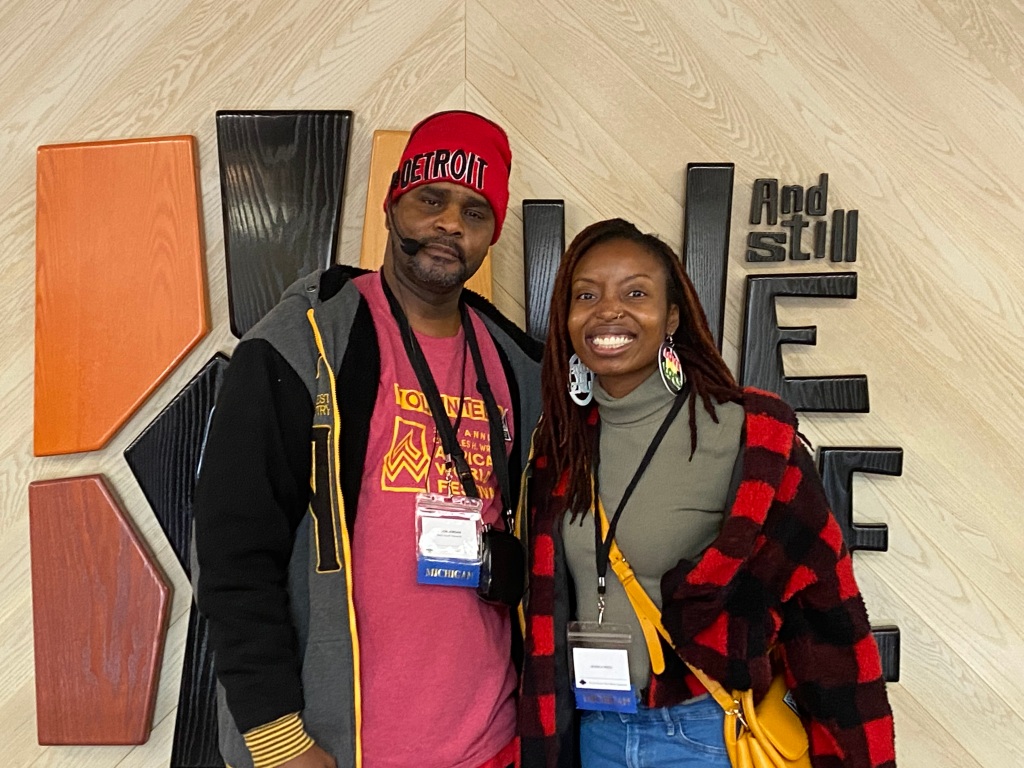
When I met Baba Jamon Jordan, I marveled at how contagious and inspiring Black study can be. Some years ago, Baba Jamon started the Black Scroll Network, with which he takes people on bus tours around Detroit. Now the official historian for the city, he paints in-depth narratives about key sites, like 12th & Clairmount Street where the 1967 Rebellion started.
Baba Jamon Jordan & me
expression
“Black midwesterners are everywhere.”
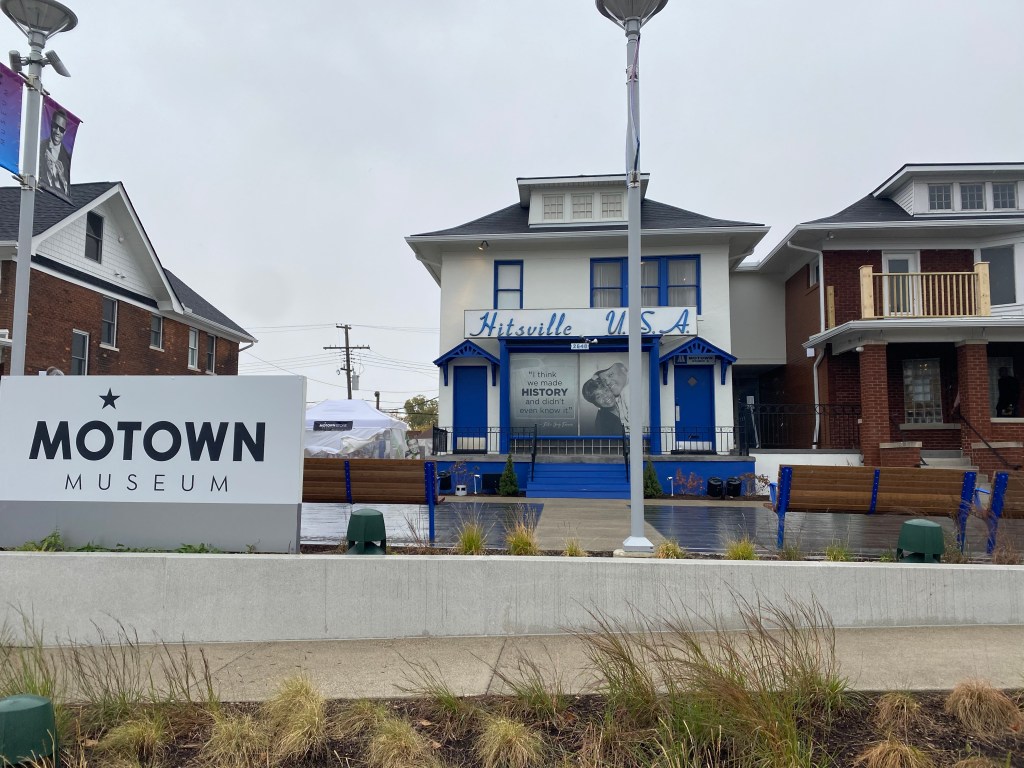
To begin the conference, poet and author Hanif Abdurraqib led a reading and conversation with fellow authors, Aaron Foley and Tamara Winfrey-Harris. These artists acknowledged how Black innovation and creativity in and from the Midwest have long been rich, yet undervalued. Hanif shared stories about loving punk and hip hop music as a kid in Columbus, Ohio. He mentioned how Detroit has the most active rap scene right now, only second to Atlanta. On the note of music, there’s also, of course, Motown, and basements in Dayton were the birthplaces of funk music. Through artistic expression, Black midwesterners, even if they move beyond the region, are archiving these histories and presences.
***
As always, the weather is wilin’ out up here in Michigan. One day, it’s in the 40’s with snow flurries. The next day, it’s a high of 70 degrees and mostly sunny. My allergies are fed up, and my Vitamin D tank knows winter is coming back real soon. As peculiar and complicated as things can be in the Midwest, it means something to be here, learn home, and carry it with me.
To learn more about the presenters at this year’s Black Midwest Symposium, gohere.
To whom can the title, educator, call home? How is it defined and fully embodied? Questions like these underlie my life’s hope of honoring legacies and possibilities for Black, intergenerational wisdom and healing.
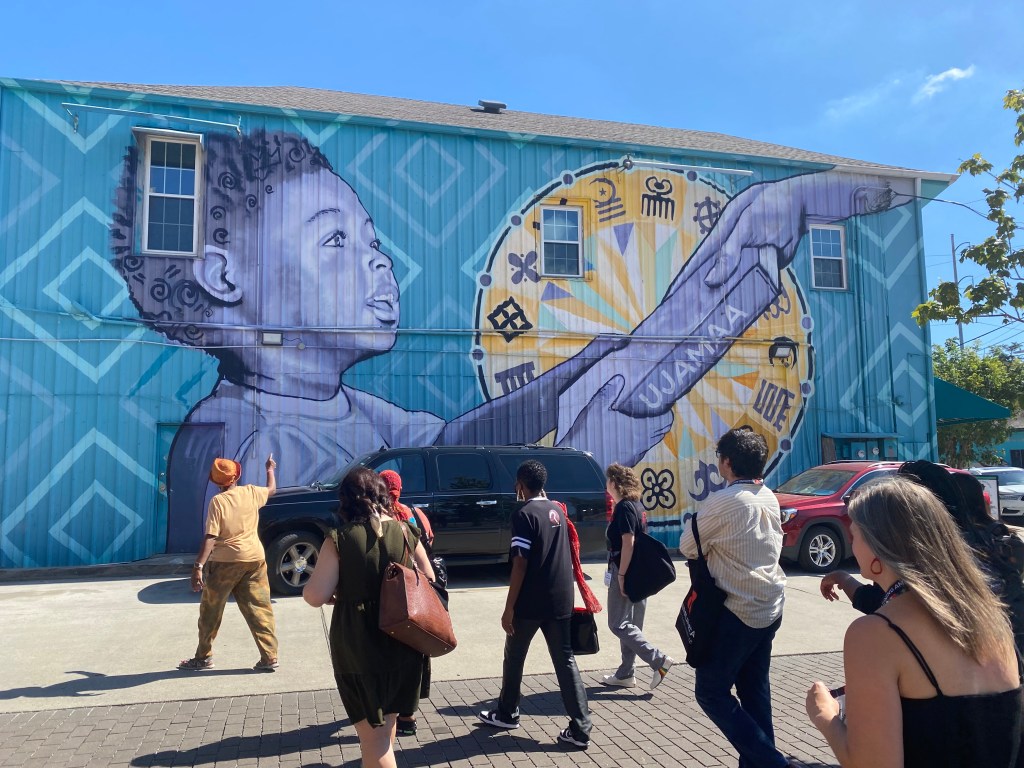
In mid-October, a graduate school fellowship brought me back to New Orleans, Louisiana. My first time going was in July 2019. That time around, I ate good (yep, the grammar is intentional), visited Studio Be, went on a swamp tour, sweatily wandered around the French Quarter, and loved the mess out of Frenchman’s Street. For my recent trip, though, my focus was divided between participating in the Imagining America: Rituals of Renewal & Repair conference, bonding with my crew from school, and getting to know locals in unexpected ways.
Considerable time has passed since I was in N’Awlins, but it’s not too late to uplift some people I was fortunate to meet. To say “thank you” to them (for their presence, hospitality, and knowledge), I’m spreading the word about their love for themselves and their communities:
TWO Black Women of Bayou ROAD
Mama Vera and I standing outside of the Community Book Center on the historic Bayou Road
I met Dr. Robin Vander and Mama Vera during a visit to the historic Bayou Road. In an era of ruthless gentrification, the street resounds with unapologetic Black ownership and agency.
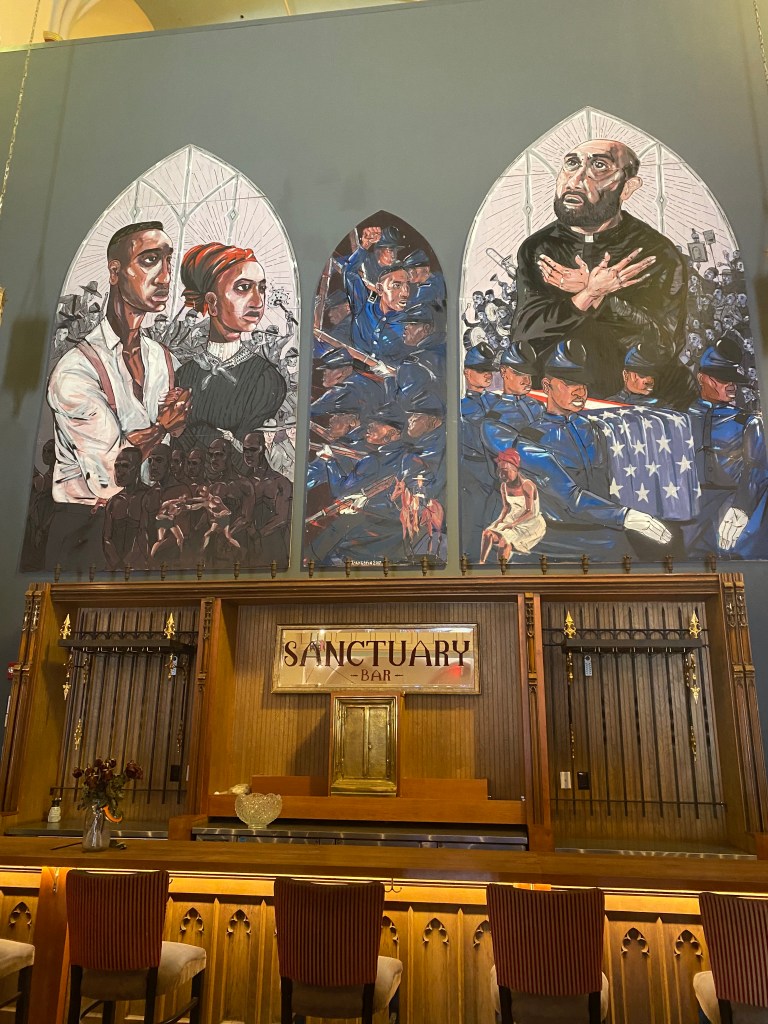
A professor at Xavier University and mentee of Mama Vera, Dr. Vander is committed to Bayou Road’s André Cailloux Center for Performing Arts & Cultural Justice. Named after a formerly enslaved Black man and Union army leader, this space is a platform for emerging Black playwrights and artists. Its high-ceiling front room resembles a church sanctuary where the community can rest, see each other, and celebrate. The center also has a mobile black box theater for rehearsals and shows.
Dr. Vander reflected, “A lot of times, culture bearers do not profit while others come in and appropriate. This center will be an ecosystem and hub for arts, culture, and sustainability.”
The inside of the André Cailloux Center
I was curious about how Dr. Vander navigates working in academia while aiming to be for the people and the community, above all. This part of her journey isn’t without tension. Yet, she seeks grounding in her work at the André Cailloux Center and learning from lifelong teachers. As an educator, she refuses to have her students settle intellectually, artistically, and in practices of justice.
Candice Langston, one of two millennial organizers in the room, talked with us about coming from the low-country of South Carolina. She never grew up thinking her schools were lacking.
“Our resources were ourselves.”
Currently working in New Orleans, she is enlivened by “collective trouble and liberation,” true Black youth led spaces, and correlated pedagogy.
I got to thinking about how part of liberation is having the courage to hope, imagine, and work for it in communities of trust. While on Bayou Road, I felt grateful to be a part of dialogic and physical spaces that were alive and audacious.
Next door to André Cailloux is Mama Vera’s Community Book Center, which launched 39 years ago. As a substitute teacher, Mama Vera lamented the lack of books amplifying Black youth and culture. Before getting a storefront, she sold books out of her car and parents’ house. While coming up in the Lower Ninth Ward, “community schools” were customary. She told us how kids would walk to school together and pass by Black women owned businesses. Everyone who was a part of the local school ecosystem had roots in the community.
After Hurricane Katrina, the state capitalized on a deficit-laden mythology they were already pushing about public schools. The “Recovery School District” came in and converted historically rich sites of learning into charter-run experiments.
“I want you all to imagine a school district for a metro city like New Orleans being 100% charter.”
“Imagine how the babies feel.”
In an ironically classroom-like setting, Mama Vera challenged us to consider the generational impact of the state takeover. Teachers, mostly Black women, lost their jobs and political participation attached to homeownership and school board representation. In deed, they were told that they were unqualified to educate Black children. Unless attending private schools, families became profit generators, whose trajectories remain at the whim of a lottery system. It is common to see billboard advertisements for charters and have siblings inconveniently divided between multiple prison-like schools. Parents, too, are treated as less than and blamed for their students’ academic challenges as if systemic theft of Black opportunity doesn’t exist.
Yet, as always with Black folk, injustice doesn’t have the last say.
“Education is not just about the dreaming or imagining, but the daring. It’s knowing the questions to ask. We need genuine educators who are paying attention. Education is the one thing that can’t be taken away from us,” said Mama Vera.
I’ll be thinking about Mama Vera for a long time. She was firm, straight up, and about that life when it comes to Black children.
“If a book could be written about your legacy, what would you want it to say?” I asked her.
“If I could help somebody…” she responded.
Selah.
In New Orleans, Black people continue to preserve, create, educate, and dare for more. Mama Vera uses “storytelling for reclamation and change,” which was the theme of our session together. After Katrina, “If she had it, the whole neighborhood had it.” People could come to the book center to use the telephone, fax documents, or any other resources available.
Beyond generating literary access, the Community Book Center is an all-knowing hub. When I walked inside, I inwardly smiled at who I assumed to be a father reading with his children. I scanned the bulletin board announcing events and initiatives flourishing across the city. With the purchase of a few books, I received a handout explaining the mission of the center and how to stay connected.
I didn’t want to leave Bayou Street, so I stayed while the rest of my group returned to the conference. Within a 15-minute time span, I met a Black cartoonist and a younger guy who has his own community organization. Before I left, Mama Vera offered to be my compass and pointed me to nearby businesses. I bought a fruit bowl from Froot Orleans, where the adolescent Black girl working the register told me, “You are so pretty.”
word is bond: TWO Black Women Loving Black youth in speech & action
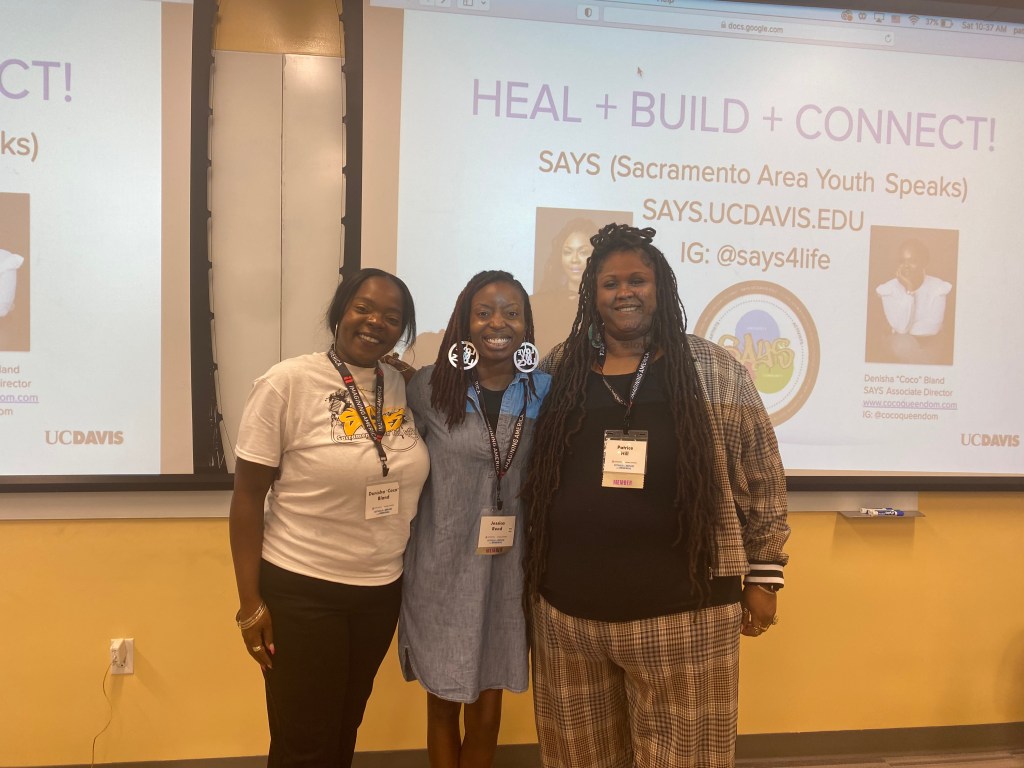
Denisha “Coco Blossom” Bland (left), me (center), and Patrice Hill (right)
Through spoken word, Patrice Hill and Denisha “Coco Blossom” Bland introduced themselves to us. Their workshop was all about “Cultural Revival: Using Spoken Word as a Ritual of Repair and Resistance.” These Black women co-lead Sacramento Area Youth Speaks (SAYS) in their hometown.
They maximize support from the University of California-Davis, declaring, “The university has an obligation to invest in the community.”
SAYS abides by the fifth element of hip hop: knowledge of self. Their pedagogy is all about supporting youth with understanding, loving, authoring, and expressing themselves in school, life, and society. This way of being, teaching, and knowing drives their five programs, which include Project HEAL (healing, education, artivism, and literacy) and the Sacramento Youth Poet Laureate Program.
Going by Mama and Auntie, Patrice and Denisha make it their mission to show up. Happening five days per week, their credit elective classes center art, truth, spoken word, and poetry practice. They hype up their young people off-hours at parties, proms, games, and other occasions. Without apology, they stay on school and university administrators about delivering resources. The students also bond through off-campus trips to colleges, art festivals, and conferences. This year, Alexandra Huynh (a SAYS alumus) is the National Youth Poet Laureate, succeeding Amanda Gorman.
“Young people challenge us to bring our best self forward. This is more than a class. This is really God’s work,” they shared with us.
To sustain relationships and the program overall, they practice integrity, self-care, expanding their team when possible, and strategizing for the future. So far, soft-funding from UC-Davis, arts commissions foundations, and grants have helped them to do worthy work. Sometimes, though, the funding isn’t always enough. Still, they won’t violate the essence of SAYS to acquire dollars.
“We’re not willing to compromise who we are to take funding.”
It was major for me to hear that. A lot of my upbringing and early career is connected to nonprofit youth programs. As an adult, it was full circle for me to be able to return to Detroit and grow alongside Black youth. I grew attuned, however, to the cost of relying on funding structures that keep inequities in place.
We, the attendees, weren’t just inspired by their work and let off easy. They gave us the prompt, “I am not who you think I am.” For five minutes, we picked up a pen without letting it go. We, then, looked at each other in a circle and told each other who we call ourselves.
Here’s a piece of what I wrote:
I am a testament that more than one thing can be true at once.I yield authenticity. I yield trembles that tumble out the soft trumpet of my throat into words spoken by faith. I smile at myself in the mirror. I sing praise songs in the shower and Al Green in the car. I cook up soul in community. My soles touch soil where I sow and we sow and you sow because we believe that one day, we’ll harvest. We believe we are each other’s harvest.
who educates ‘we’?
New Orleans reaffirmed that school ain’t the only place to practice education, if it even does.
An educator can be the family griot, neighborhood journalist, book center owner, graphic novelist, youth leader, community organizer, cultural muralist, schoolteacher, preacher, dancer, archivist, parent, child, grandmother, great uncle, lyricist, or poet laureate. It can be the Black security guard I met on the rooftop of the NOPSI hotel, who recently returned to New Orleans after leaving post-Katrina. As we stood on elevated concrete in the Central Business District, he pointed out the ghosts of people and companies that fled the city soon after the storm passed.
“You see right there? That used to be a business, but now, it’s just apartments. Up there was Lionel Richie’s apartment, but even he left.”
You can’t depend on textbooks to tell you about yourself. You gotta listen to people, listen to yourself, and face the questions that require something of you.
Perhaps, you are in a season of yearning for companionship, whether romantically, platonically, or through community in another context. Maybe, you’ve grown frustrated searching for a church home or seeking mentors who can support you. Your desires are valid. Not feeling seen, connected, or chosen is painful. What if God sees you, though, in ways that surprise you? What if in your seasons of uncertainty and obscurity, God wants to show you that He has never left you, remembers you, and covers you? What if, through everything, God is positioning you to help others feel loved, purposed, and seen?
Recently, God smiled at me while I participated in a conference called the I Am Experience. With a mixture of apprehension and excitement, I kept my “yes” to the invitation to attend. Back in July, I suffered a consequential concussion that made it difficult to function, let alone socialize for a sustained period of time. In the months to follow, I battled depression from the isolation that my condition necessitated. As October approached, I was grateful to feel well enough to show up to I Am and see what God could do.
Founded by Detroiter Orena Perry, the fifth annual I Am Experience was themed “Woman…I See You.” Over the course of a weekend, women from across walks of life were encouraged to open their eyes and see Christ. Although I could only join for one day, the Word of God was magnified to me in a needed way:
“God showed how much he loved us by sending his one and only Son into the world so that we might have eternal life through him. This is real love—not that we loved God, but that he loved us and sent his Son as a sacrifice to take away our sins.
Dear friends, since God loved us that much, we surely ought to love each other. No one has ever seen God. But if we love each other, God lives in us, and his love is brought to full expression in us.”
(1 JOHN 4: 9-12, NEW LIVING TRANSLATION, HOLY BIBLE)
Ms. Perry’s courage resulted in women at I Am being beautifully called to see God through how we love each other. In gratitude to her and the team that helped actualize this conference, I am compelled to share 5 lessons/reminders that remain close to me:
Earnest prayer is personal and powerful.
Day 2 of I Am began with a prayer breakfast. Multiple women led us in prayer, which each centered on a specific area, such as finances or mental health. No two people conversed with God in the same way. Yet, everyone spoke from a posture of love and dependence on our Creator. So long as a prayer is earnest, it is worthy.
Intergenerational community is a gift.
“Don’t let anyone think less of you because you are young. Be an example to all believers in what you say, in the way you live, in your love, your faith, and your purity.”
(1 Timothy 4:12, New Living Translation)
“Wisdom belongs to the aged, and understanding to the old.”
(Job 12:12)
Greater is possible when our hearts and ears are willing to be blessed by those older and younger than us. None of us have it 100% right, but we all have something to offer from our unique stories in progress. The I Am conference honored legacy and cross-generational encouragement.
D’Lila Brumfield, daughter of Orena Perry, reflected, “Being a part of the I Am Experience every year is more than just helping my mother host a multicultural, multi-generational women’s conference. It is a position of great privilege to serve these women and watch moments of transformation happen session by session. It really means the world to me to provide opportunities of exchange and excellence to others, in a way that promotes wholeness and wellness for everyone involved. It’s really a joy to be a part of.”
Grief ain’t nothing to be ashamed of.
Panelists and attendees openly grieved at various points during the day. Whether remembering a late spouse or sharing about current hard losses, I Am modeled an atmosphere where people could be without pretense. In those moments, a consoling hug or an offer of Kleenex were not intended to quicken one’s tears. They were, rather, paired with softness and recognition.
“Take your time to feel, sis. We got you.”
Visions come to pass through remembrance, preparation, and time.
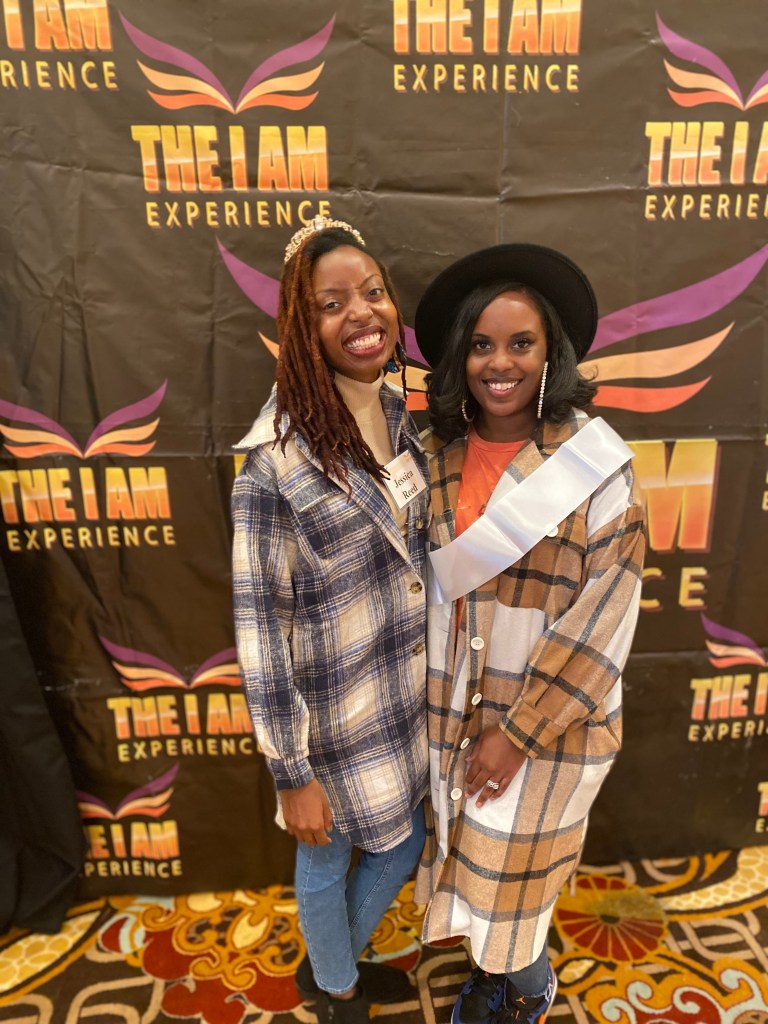
My friend and sister, Deja, participated in I Am as a panelist and listener.
She told me, “The event was a reminder and rekindler of what God has been speaking to me since 2018. The vision He placed on the inside of me regarding women and how my story has a place to be heard and my experiences are to be learned from. The I Am experience was a place of rebirth and a much needed space to share and commune with other dope women.”
Has God planted a vision in your heart? Don’t laugh at it. Take it seriously. Pray on it. Show up to spaces that help you remember and believe for what you saw. Treat life’s highs, lows, and in between as preparation and not waste.
Deja and me 🙂
Your crown looks stunning on you. Wear it.
At the end of the day, we were gifted crowns and directed to place them on each other. With the help of a compact mirror, we then looked into ourselves and confessed we were worthy. We kept on our crowns as we left the conference and passed by strangers who joked about wanting adornments, too.
What might you see in the mirror if you began crowning yourself in kindness and acceptance each morning? What freedom, too, might you experience if you sought out opportunities to crown others with words and actions rooted in love, recognition, and faith? What might you see, if not the love of God?
1. You will learn that it is beautiful and okay to need support.
If none of us ever supported each other, how would we survive? What gifts and stories would we rob people of showing? What aches and fears would we unnecessarily continue to suffer through? How fulfilling was it when you have offered time and expertise to someone? Even if you feel afraid, reach out to that person who inspires you in area(s) in which you hope to grow.
2. You will learn to ask questions and be teachable.
I’ve learned that you don’t have to immediately ask someone to mentor you. You can simply introduce yourself (via email, social media, or in person), express how their work and/or being resonates with you, and ask if they would be willing to briefly meet with you and share insights. Prepare some thoughtful questions based on research and curiosity. Chances are that they’ll be excited to chat and learn about you, too! When your first meetup concludes, you can ask if they would be open to you keeping in touch!
3. You will learn to enact wisdom and see results.
At the risk of sounding “school-y”, do your homework. Actually look into the literature, resources, and contacts that your mentor recommends. Follow up with them about your takeaways and goals for life application. Also, actually pay attention to any prompts for personal and professional reflection. Plant organic fruit by investing in yourself.
4. You will learn that “this, too, shall pass.”
All of my mentors have motivated me to believe in a larger, more hopeful picture. They encouraged me to literally stay alive. Whenever I struggled financially, mentally, emotionally, spiritually, and the list goes on, I was reminded of “next pages” and all things connecting for my good. Something that’s been major is my mentors’ transparency about trials that once consumed them. With time and support systems, they continue to press through!
5. You will learn that there is grace for the process.
I’m fasho not always patient with myself. If it were up to me, I would choose a tear-free, mistake-free, and expedited path toward growth. My mentors help me to move at the pace of grace, which often times requires stillness and forgiveness.
6. You will learn that learning is lifelong.
Though mentors are educators, they are also learning within the context of their own journey. They’ve had mentors of some kind, too. I’m gradually understanding that learning is something that I always can look forward to, with gratitude.
7. You will learn that more is possible and to never settle.
Don’t settle for a scarcity mindset. Don’t settle for safe living. Choose more than chasing wind. Be grateful, cultivate integrity, and make God primary (as many times as you have to).
8. You will learn to receive love and savor celebration.
It feels so good (Teddy Pendergrass voice) when people (who know how far you’ve come and believe in how enough you’ll always be) celebrate your blossoming. They teach you how to celebrate yourself and your loved ones.
9. You will learn that you, too, are generative.
It’s already something inside of you that will bless your peers, elders, and generations after you!
10. You will learn how to pay it forward by becoming a mentor.
Thank your mentors by showing up for others. You don’t have to be perfect. You just have to be available.
BonusTips:
Don’t dwell in discouragement if your search for mentor(s) takes time.
Similar to friendships, some mentors are only for a season. With discernment and intention, own your part in sustaining mentoring relationships.
Some mentors aren’t people you know in real life—though I believe those individuals are crucial. Perhaps, some counselors for you are authors, podcast hosts, historians, or pastors.
You can have a village of mentors who speak to different parts of you. They can include trusted folks in your family as well.
***
To all my mentors, thank you beyond measure! I love you so much.





 Roots & Hope